

How did certain businesses become such global phenomena so quickly? What was it that made companies like Uber and Deliveroo so successful, for example?
Experts will say there was no single factor, but they will agree that both built business models that could serve more customers without costs rising at the same rate. Technology, repeatable processes, and a clear growth strategy allowed them to expand quickly and consistently.
Your ambitions may be more modest, but the same principle applies. Whether you want to enter new markets, boost your client base, or broaden your offering, sustainable growth depends on building a business that can handle greater demand without sacrificing profitability.
Key takeaways
- Scaling a business means increasing revenue without allowing costs, workloads, and operational complexity to rise at the same rate.
- A business is ready to scale when demand is proven, cash flow is stable, and key processes are repeatable.
- Strong cash flow, efficient customer acquisition, and enough delivery capacity are essential before increasing demand.
- Systemising tasks, documenting processes, and using technology can help the business grow without relying on constant manual input.
- Clear roles, relevant KPIs, and the right mix of employees, specialists, and outsourced support help sustain profitable growth.
Here’s what we’ll cover:
What does it mean to scale a business?
Scaling a business means increasing its revenue and customer base without allowing costs, staffing requirements, or operational complexity to rise at the same rate.
A scalable business can serve more customers while maintaining its profitability and the quality of its products or services. This usually requires the business to systemise repeatable tasks, improve processes, use technology effectively, and reduce its dependence on the founder or individual employees.
For example, a business might introduce software that automates administrative work, document its sales and customer service processes, or create a product that can be sold repeatedly without being rebuilt for every customer. These changes make it possible to handle greater demand without having to increase resources proportionately.
Scaling does not necessarily mean expanding as quickly as possible. Sustainable scaling involves building the systems, capacity, cash flow, and leadership needed to support growth without putting excessive pressure on the business.
What is the difference between growing and scaling a business?
Growing and scaling are closely related, but they are not opposing choices; rather, scaling is a particular way of growing a business.
A business grows when it increases its revenue, customers, workforce, or market presence. However, this growth may require a similar increase in costs. For example, a consultancy might need to hire another employee each time it takes on a certain number of new clients.
A business scales when revenue increases faster than the resources needed to generate it. Instead of simply adding more people, premises, or materials, the business finds more efficient and repeatable ways to operate.
This distinction can be summarised as follows:
- Growth increases the size and revenue of the business, often alongside higher costs.
- Scaling increases revenue while keeping the corresponding rise in costs and resources proportionately lower.
Some investment will usually be required before a business can scale. You may need to recruit people, install new equipment, or redesign existing processes. The aim is not to eliminate additional costs but to create a business model that can support more customers and revenue without costs continuing to increase at the same rate.
Understanding how scaling can increase profitability
To help make this clearer, let’s look at a simplified example of a three-year plan showing the impact of scaling versus growth on profit.
We will assume that a small business has revenue of £500,000, costs of £400,000, and profit of £100,000. After three years of growth with both revenue and costs rising 20% year on year, profit will have increased by 73%.
Take the same business with the same assumptions, but instead of costs increasing at 20%, assume we adapt the business model to embrace scaling and costs rise at 5% year on year.
After three years, the profit has increased by 301%.
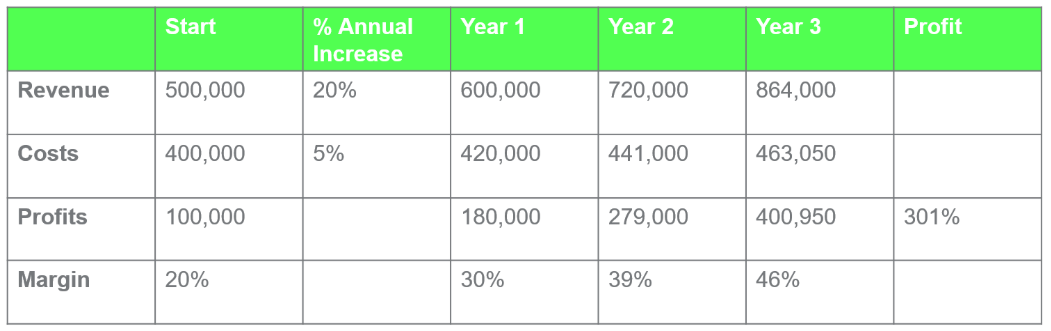
More importantly, costs will have gone up by 33% less while scaling, resulting in a much more manageable impact on cash flow.
It is a simplified example but provides a good illustration of how scaling provides profitable and sustainable growth.
How to scale your business in five steps
Scaling a business requires you to establish a clear strategy, build up your cash flow, work on increasing your capacity efficiently, systemise processes, and upskill your staff to handle increased responsibility.
These five steps can help you build a business that is ready for sustainable, profitable growth.
1. Develop a clear scaling strategy
Start by defining what scaling should look like for your business. This means understanding your position in the market, where the strongest opportunities lie, and how you will differentiate your products or services from those of your competitors.
Set clear objectives for revenue, profitability, customers, and market expansion, along with a realistic timeframe for achieving them. You should also identify which parts of your business are already scalable and which could become strained as demand increases.
- Assess the strengths and weaknesses of the business across areas such as operations, technology, financial management, risk, and governance so you can identify what must improve before you scale.
- Involve employees in shaping the strategy where appropriate. People who work closely with customers and day-to-day processes may identify constraints or opportunities that senior leaders overlook.
A clear strategy gives your team a shared direction. It helps people understand how their roles contribute to the company’s future and allows you to prioritise investments most likely to support sustainable growth.
2. Strengthen your cash flow
Scaling usually requires investment before it generates higher returns. You may need to recruit employees, adopt new technology, increase production, or spend more on sales and marketing.
Review your cash flow forecasts to understand how much funding you will need and when you will need it. This will help you prioritise investments while continuing to cover payroll, supplier payments, and other operating costs.
The right technology can help you scale more efficiently. For example:
- Sales technology, such as customer relationship management software, can help teams track leads, manage pipelines, and forecast future revenue.
- Marketing technology can automate email campaigns, customer segmentation, and performance reporting, helping you identify which channels generate the strongest returns.
- Accounting software can automate invoicing, monitor expenses, provide real-time cash flow information, and highlight late payments before they become a larger problem.
Technology should solve a clear operational or financial need rather than add unnecessary complexity. Consider the initial cost, ongoing fees, implementation time, and expected savings or revenue gains before investing.
It is also sensible to maintain a cash reserve. Sales may take longer than expected to materialise, new employees may need time to become fully productive, and unexpected costs can arise during expansion. A financial buffer gives you more room to adapt without disrupting the business.
3. Build capacity efficiently
Consider how your business will acquire and serve more customers without increasing resources at the same rate as revenue.
This may involve recruiting people with specialist skills, outsourcing selected activities, or using technology to help your existing team work more efficiently. Focus on the roles and capabilities that will remove constraints and support the next stage of the business.
Before increasing demand, assess whether your sales, marketing, and customer service functions can manage it. Growing sales without the capacity to deliver can damage service quality, employee morale, and customer trust.
Pay particular attention to:
- Customer acquisition economics: compare your customer acquisition cost with the lifetime value of each customer. Lifetime value should be comfortably higher, leaving enough margin to cover delivery costs and remain profitable as sales increase.
In-house versus outsourced support: decide which acquisition activities need to stay within the business. Outsourcing lead generation can add capacity quickly, but it works best when you have clear targeting, performance measures, and a reliable process for converting qualified leads.
4. Systemise your processes and execute consistently
To scale successfully, your business must be able to deliver a consistent experience as the number of customers, employees, and transactions increases.
Start by identifying recurring activities in areas such as sales, onboarding, customer service, finance, and fulfilment. Document how these tasks should be completed, assign clear ownership, and establish standards that employees can follow.
Look for opportunities to simplify or automate routine work. For example, software could help you manage invoices, customer communications, appointments, or internal approvals. The goal is not to automate every activity but to reduce unnecessary manual work and free your team to focus on tasks that require judgement or expertise.
Systemising your business also reduces its dependence on individual employees or the founder. When essential knowledge is documented and processes are repeatable, the business can continue to operate effectively as the team changes or expands.
However, systems only create value when they are followed and improved. Monitor performance, collect feedback, and refine processes when they no longer deliver the required quality or efficiency.
5. Develop the right leadership and skills
Scaling changes what a business needs from its leaders and employees. The skills that helped you establish the company may not be enough to manage a larger team, enter new markets, or oversee more complex operations.
Assess the strengths and weaknesses of your current team and identify any gaps that could prevent the business from progressing. Depending on your needs, you might:
- Develop existing employees so they can take on more responsibility.
- Recruit experienced leaders or specialists.
- Bring in external advisers for targeted support.
- Hire new staff or virtual assistants to manage non-core tasks such as administration, scheduling, data entry, or routine customer enquiries.
Delegating this work can free senior employees to focus on strategy, customer relationships, and other activities that directly support growth.
As roles evolve, define clear responsibilities and key performance indicators for each position. Relevant KPIs could include:
- Sales generated or leads qualified.
- Customer response times or retention rates.
- Project delivery against deadlines.
- Processing accuracy or productivity.
- Other outcomes the role can directly influence.
Avoid measuring activity for its own sake. KPIs should show how each person contributes to the company’s wider scaling objectives.
Clear expectations help employees understand their priorities and make it easier to identify where additional training, support, or resources are needed.
You should also look for employees with the potential to become future leaders. Developing people and delegating decisions reduces the business’s reliance on a small number of individuals.
Keep in mind that you don’t have to make every scaling decision alone. Mentors, professional networks, advisers, and leaders of similar businesses can help you anticipate challenges and question assumptions. Learn from their experience.
How do you know your business is ready to scale?
A business is ready to scale when it has proven demand, reliable finances, and processes that can support more customers without creating unsustainable costs or workloads.
Strong sales alone are not enough. If growth already puts pressure on your cash flow, employees, or customer service, increasing demand could make those problems worse. Before scaling, look for the following signs.
- Demand is consistent: you have a steady flow of customers rather than relying on a temporary surge, one large contract, or seasonal sales.
- Your business model is profitable: you understand your margins and know that serving more customers should increase profit, not simply create more work and expense.
- Cash flow can support investment: you have enough working capital, funding, or cash reserves to cover recruitment, technology, marketing, and other costs before they generate a return.
- Your processes are repeatable: important tasks are documented and can be completed consistently without relying on the founder or one experienced employee.
- Your team has capacity: employees can manage current workloads effectively, and you know which skills or roles will be needed as the business expands.
- Your offering has room to expand: you understand your competitive advantage, the size of the potential market, and whether your product or service can be sold to more customers or in new markets.
- Quality remains consistent: your products, services, and customer support meet the same standards as demand increases.
- Your technology can handle growth: existing systems can support more users, transactions, data, and employees or can be upgraded without disrupting the business.
- You have clear performance measures: you can track revenue, profit, cash flow, customer acquisition costs, retention, and operational performance.
You should also have a clear reason for scaling. This might be strong demand in your existing market, an opportunity to expand into a new location, or the potential to sell a proven product to a wider audience. Scaling simply because the business has grown recently can lead to rushed investments and unnecessary risk.
Few businesses will be perfectly prepared. The aim is to identify the main constraints before they become serious problems. If demand is proven, finances are stable, and the business can deliver consistently without depending on constant intervention from you, it may be ready for the next stage of growth.
Scale your business without sacrificing profitability
With the right strategy, systems, people, and financial controls in place, you can expand your business while protecting service quality, cash flow, and profit margins.
The aim is not to grow as quickly as possible but to build a business that can handle greater demand sustainably. Review your performance regularly, address constraints early, and keep refining the way your business operates as it grows.
Frequently asked questions
Not every business can be scaled in the same way. Businesses that rely heavily on the founder’s time or highly customised work may need to standardise services, improve processes, or introduce technology before they can grow efficiently. But most businesses can become more scalable, even if they cannot expand rapidly.
Common mistakes include expanding before demand is proven, hiring too quickly, neglecting cash flow, failing to document processes, and focusing on revenue instead of profitability. Scaling without sufficient operational capacity can also lead to declining customer service and increased costs.
Not always. Some businesses can fund growth through retained profits and healthy cash flow, while others need external finance to invest in staff, equipment, technology, or marketing. The right approach depends on how quickly you want to scale and the resources required.
A business should delay scaling if demand is inconsistent, cash flow is unstable, operations are disorganised, or customer satisfaction is already declining. Solving these issues first reduces the risk of expensive mistakes during expansion.
Yes. Scaling is not limited to large companies. Many small businesses increase revenue by improving efficiency, automating routine work, standardising services, and building systems that allow them to serve more customers without proportionally increasing costs.
Browse more topics from this article
PakarPBN
A Private Blog Network (PBN) is a collection of websites that are controlled by a single individual or organization and used primarily to build backlinks to a “money site” in order to influence its ranking in search engines such as Google. The core idea behind a PBN is based on the importance of backlinks in Google’s ranking algorithm. Since Google views backlinks as signals of authority and trust, some website owners attempt to artificially create these signals through a controlled network of sites.
In a typical PBN setup, the owner acquires expired or aged domains that already have existing authority, backlinks, and history. These domains are rebuilt with new content and hosted separately, often using different IP addresses, hosting providers, themes, and ownership details to make them appear unrelated. Within the content published on these sites, links are strategically placed that point to the main website the owner wants to rank higher. By doing this, the owner attempts to pass link equity (also known as “link juice”) from the PBN sites to the target website.
The purpose of a PBN is to give the impression that the target website is naturally earning links from multiple independent sources. If done effectively, this can temporarily improve keyword rankings, increase organic visibility, and drive more traffic from search results.