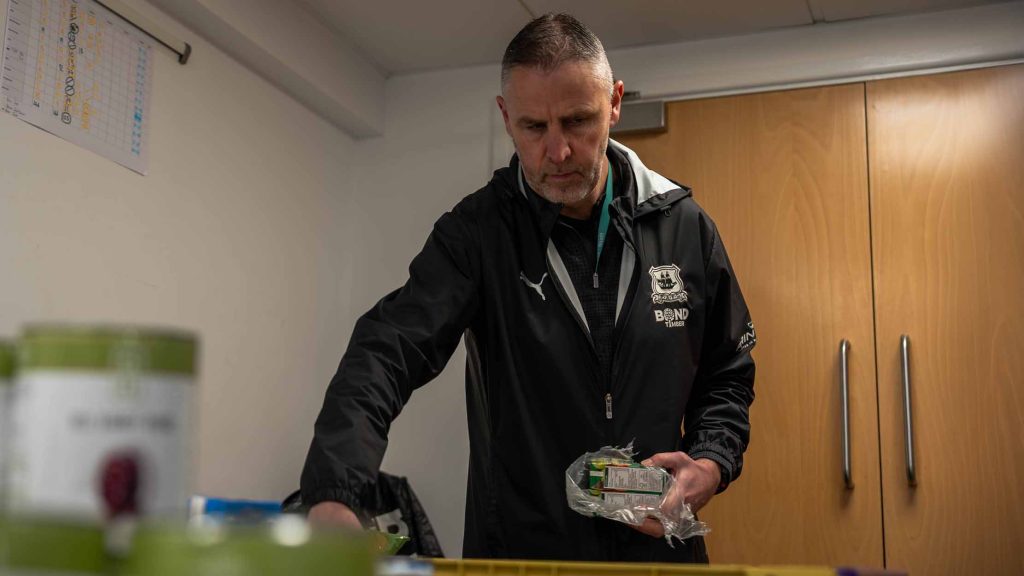

Plymouth Argyle Football Club’s community trust, known as Argyle Community Trust, has moved far beyond the boundaries of football.
It has built a network of social support that touches the lives of some of the city’s most vulnerable residents.
Read on to learn more about this outstanding organisation. Here’s what we cover:
Team identity: A force for change
From child poverty reduction to mental health intervention, Argyle Community Trust demonstrates how a football club’s identity can be a genuine force for change.
As well as winning the EFL’s Community Club of the season 2024/25, the Trust supported 101,218 people, aged from four months to 100 years old, delivering more than one million contact hours.
Watch the video above, which explores the Trust’s approach and the partnerships that sustain its work.
A city with hidden deprivation
Plymouth has an image that doesn’t quite match its reality. Its coastal location and rich history make it easy to assume the city is prosperous, but that’s not the whole story.
Argyle Community Trust’s Head of Business Development, Dwain Morgan, is frank: “There’s this misconception that Plymouth, being based down in sunny Devon and on the border of Cornwall, is a very affluent middle-class place where everybody flourishes, but actually Plymouth has a lot of social issues.”
Those issues include high levels of adult illiteracy, multi-generational unemployment, food insecurity, and fuel poverty—challenges that are all deepened by the area’s rural isolation.
The scale of child poverty prompted action. The Trust uncovered findings showing that, on average, 35% of children in Plymouth experience daily poverty.
Rather than wait for others to act, the club and Trust concluded that their position, resources, and community relationships gave them both the capability and the obligation to try to drive change.
That decision marked a fundamental shift in the Trust’s mission.
Why Project 35 does things differently
Project 35 was designed in partnership with Ginsters specifically to address child poverty without adding to an already crowded landscape of interventions.
Richard Luscombe, Marketing Manager at Argyle Community Trust, explains the philosophy: “We want to help reduce that child poverty rate, but we want to do it differently and not duplicate or dilute what’s already happening across the city.”
The programme focuses on sustainable skills, teaching families how to budget effectively and how to cook nutritious meals rather than simply providing crisis relief. Food distribution remains part of the work, and ensuring people in crisis can eat is a genuine priority.
Plymouth Argyle Football Club is much deeper than the 11 men that run around on a Saturday, or the 11 women that run around on a Sunday. We’re here every second of every day, trying to drive the change to the people that need it the most.
Richard Luscombe, Marketing Manager, Argyle Community Trust
And the Trust is equally committed to building the kind of long-term resilience that reduces reliance on crisis support in the first place.
“It’s about a much more sustainable movement,” says Richard, something which is clear from the relationships the Trust has built.
Community members now engage with Argyle Community Trust across a wide range of needs, not just because of their connection to the football club, but because it has earned a reputation as a place where people genuinely care.
“It is the one consistency that they may have in their week,” says Richard.
The badge, brand, and the battle for funding
One of the Trust’s most significant assets is the Plymouth Argyle FC brand itself. The Plymouth Argyle badge opens doors a conventional charity couldn’t.
“The razzmatazz is behind the football club badge and actually being linked to the football club”, says Dwain. “It allows us to break down barriers. It really elevates us to be able to make a bigger change.”
Services that might otherwise feel inaccessible or stigmatising become approachable when they are offered under the banner of a much-loved local institution.
The breadth of what the Trust now delivers reflects this broadened reach: bereavement support, dementia groups, fall prevention for the elderly, mental health intervention, housing guidance, and unemployment advice all sit alongside sport-based programmes.
Final thoughts: Sport at the forefront of change
The Trust has the staff expertise, the physical infrastructure and, critically, the community relationships to deliver across all these areas.
Yet the funding environment presents a persistent challenge.
“There’s less money to give to more charities, and the need to spend is bigger than ever,” Richard observes.
The Trust’s strategy is to deepen its corporate and commercial partnerships, pooling resources and expertise to sustain provision.
Their ambition is to keep sport at the forefront of driving change, and to ensure that the people of Plymouth who need support the most continue to find it.
The businesses behind the badge
Want to discover your local heroes of the English Football League? Sage’s interactive map uncovers their stories.
Take a look now
Browse more topics from this article
PakarPBN
A Private Blog Network (PBN) is a collection of websites that are controlled by a single individual or organization and used primarily to build backlinks to a “money site” in order to influence its ranking in search engines such as Google. The core idea behind a PBN is based on the importance of backlinks in Google’s ranking algorithm. Since Google views backlinks as signals of authority and trust, some website owners attempt to artificially create these signals through a controlled network of sites.
In a typical PBN setup, the owner acquires expired or aged domains that already have existing authority, backlinks, and history. These domains are rebuilt with new content and hosted separately, often using different IP addresses, hosting providers, themes, and ownership details to make them appear unrelated. Within the content published on these sites, links are strategically placed that point to the main website the owner wants to rank higher. By doing this, the owner attempts to pass link equity (also known as “link juice”) from the PBN sites to the target website.
The purpose of a PBN is to give the impression that the target website is naturally earning links from multiple independent sources. If done effectively, this can temporarily improve keyword rankings, increase organic visibility, and drive more traffic from search results.